


Sports & Wellness
Slide 01 / 14

Care built over a decade.

  1. 600,000+

    People cared for

  2. 10Years

    A legacy of clinical care

  3. 50+Centres

    Across Bengaluru

  4. APTAAcademy of Pelvic Health

    Trusted by the APTA Academy of Pelvic Health to deliver its certification courses in India

Trusted by leading healthcare institutions

  • Sakra World Hospital
  • Rainbow Children’s Hospital
  • Apollo Clinics
  • NU Hospitals
  • Cytecare Hospitals
Begin presentation
Runner silhouetted against a low sun, driving upward in full stride.

Evidence update · 10 minutes

When movement becomes threatening

Interoception, body schema and autonomic regulation in complex musculoskeletal presentations.

Pro Physio · Clinical Education01
Close-up of a woman looking down over her shoulder, sweat on her skin, tension through her neck.

Why this matters

“My whole body feels stiff.”

619M

People living with low back pain in 2020 — projected to reach 843 million by 2050. Still the leading cause of years lived with disability worldwide.

GBD 2021 Low Back Pain Collaborators, Lancet Rheumatol 2023

The clinical question: when movement becomes threatening, are we treating muscles and joints — or the nervous system’s protective response to perceived threat?
Pro Physio · Clinical Education02
Illustrative image: a woman in activewear bracing against a sofa with one hand on her abdomen. Not a patient.

Case A

“Everything is stiff”

Body

  • Widespread stiffness
  • Bilateral leg pain, tingling
  • Constipation, breathing discomfort, giddiness

Behaviour

  • Abdominal vigilance
  • Pelvic-floor gripping
  • Slow, guarded, en-bloc movement

Context

  • Investigations don’t match severity
  • Unhelpful prior care experience
  • Low mood, high uncertainty
No single tissue explains this cluster. It is a sensory, motor, autonomic and threat-shaped presentation — once screening is complete.
Pro Physio · Clinical Education03
Illustrated translucent human figures showing brain, nervous system and heart.

The framework

Three systems that turn threat into stiffness

01

Interoception

How the body feels inside — and how the brain reads it.

02

Body schema

The brain’s working map for planning movement.

03

Autonomic state

The physiological background movement happens in.

Shared output: protective motor behaviour — bracing, gripping, breath-holding, guarded en-bloc movement.
Pro Physio · Clinical Education04
A hand reaching down to touch still water at sunset, ripples spreading.

Lens 01 · Interoception

Feeling a lot is not sensing well

↑ ↓

In chronic pain, attention to body signals goes up while interoceptive accuracy goes down.

Di Lernia et al., Neurosci Biobehav Rev 2016 · systematic review

d 1.17

Gain in interoceptive awareness with mind–body therapies for chronic pain, alongside pain reduction (11 studies).

Gnall et al., Int J Behav Med 2024 · meta-analysis, preliminary

Clinical translation: train calm, accurate noticing — not more monitoring.
Pro Physio · Clinical Education05
Woman seen from behind with her spine and nerves glowing through her back.

Lens 02 · Body schema

Pain blurs the brain’s map of the body

≈12 mm

Poorer lumbar two-point discrimination in chronic low back pain vs pain-free controls (19 studies, 547 patients).

Adamczyk et al., Clin J Pain 2018 · meta-analysis

−1.0

Point reduction in pain (0–10) vs sham at 18 weeks with graded sensorimotor retraining — the RESOLVE trial (n = 276).

Bagg et al., JAMA 2022 · RCT · small but specific effect

Clinical translation: a blurred map produces guarded, low-variability movement. Retrain the map, not just the muscle.
Pro Physio · Clinical Education06
Woman standing hunched, arms wrapped tightly around herself, looking up anxiously.

Lens 03 · Autonomic state

Movement happens in a physiological state

↓ HRV

Adults with chronic musculoskeletal pain show lower heart-rate variability — more sympathetic, less vagal modulation — than controls (20 studies).

Rampazo et al., Pain Pract 2024 · systematic review · heterogeneous, moderate quality

Hold the line on evidence. HRV is a state marker, not a diagnosis. Avoid labels that outrun the data (“polyvagal shutdown”). Giddiness, gut and breathing symptoms need medical screening first.
Pro Physio · Clinical Education07

How the lenses connect

The symptom–threat loop

    The patient is not overreacting. The system is over-protecting — and protection creates new sensation that feeds the loop.
    253

    Effect sizes (N = 42,463) show fear of pain tracks pain intensity — a consistent small-to-medium association.

    Markfelder & Pauli, Psychol Bull 2020 · meta-analysis

    Complex ≠ psychological. Screen neurological, systemic, medication and pelvic-floor/GI contributors first. Nociplastic pain has clinical criteria — it is not a diagnosis of exclusion (Kosek et al., Pain 2021).

    Pro Physio · Clinical Education08

    Case B · The 90-second experiment

    Day 2 after knee replacement: “Don’t bend it”

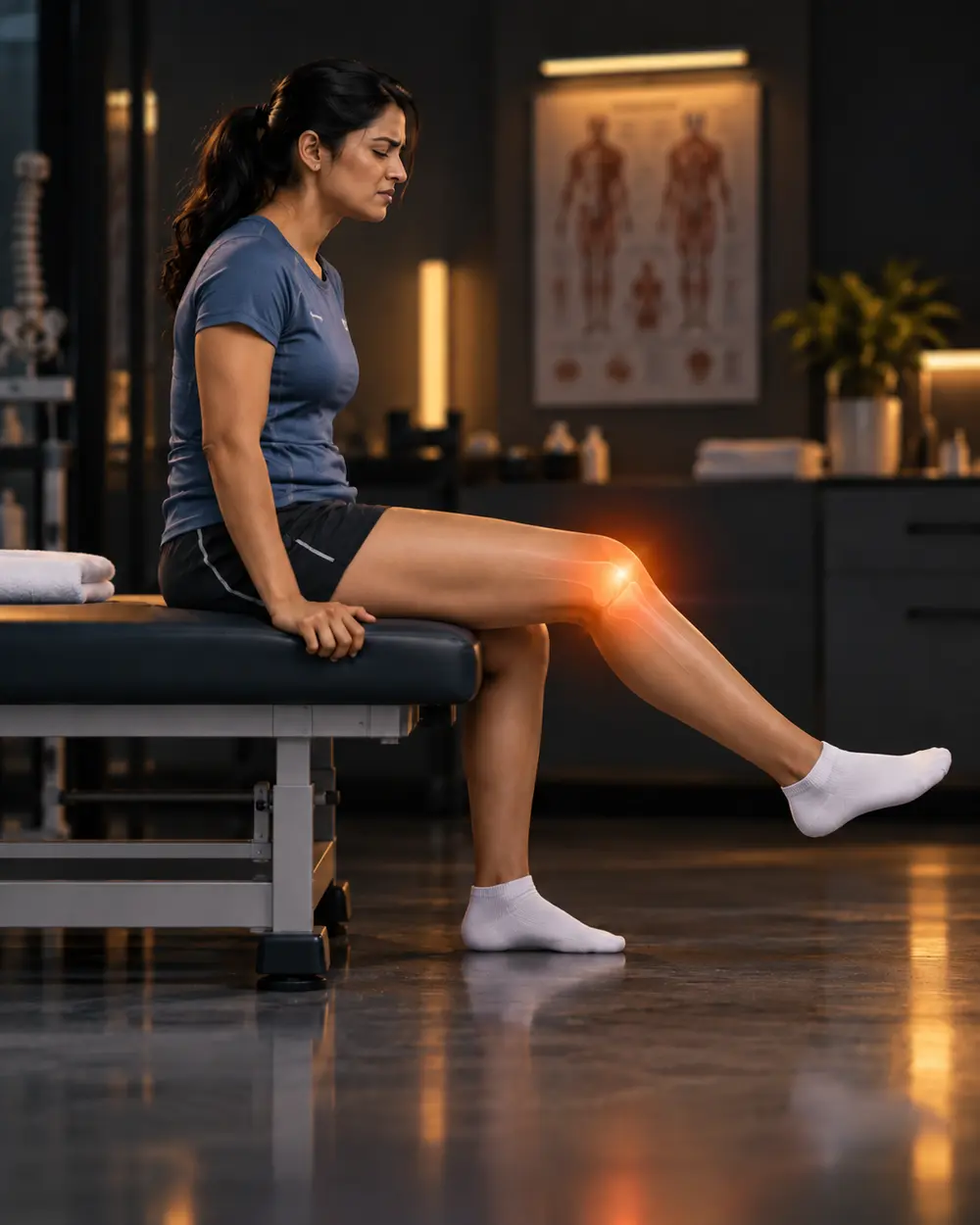
    65-year-old woman, two days after total knee replacement. Reports severe pain and refuses to bend her knee sitting at the edge of the bed.

    Screen first: analgesia timing and rebound pain as the nerve block wears off · wound and swelling · calf signs (DVT) · neurovascular status. Then test the threat.
    Illustration, trial 1: a woman sits at the edge of a treatment bed, face strained, holding her operated leg stiffly out straight while her knee glows orange-red to show a threat response.
    IMG-10A

    Knee held stiffly straight with a red threat response.

    Trial 1 · Internal / threat focus
    “Bend your knee as far as you can — tell me when it hurts.”

    Quads co-contract, hands grip the bed, breath held — stops at ≈35°.
    Pain, illustrative
    8/10
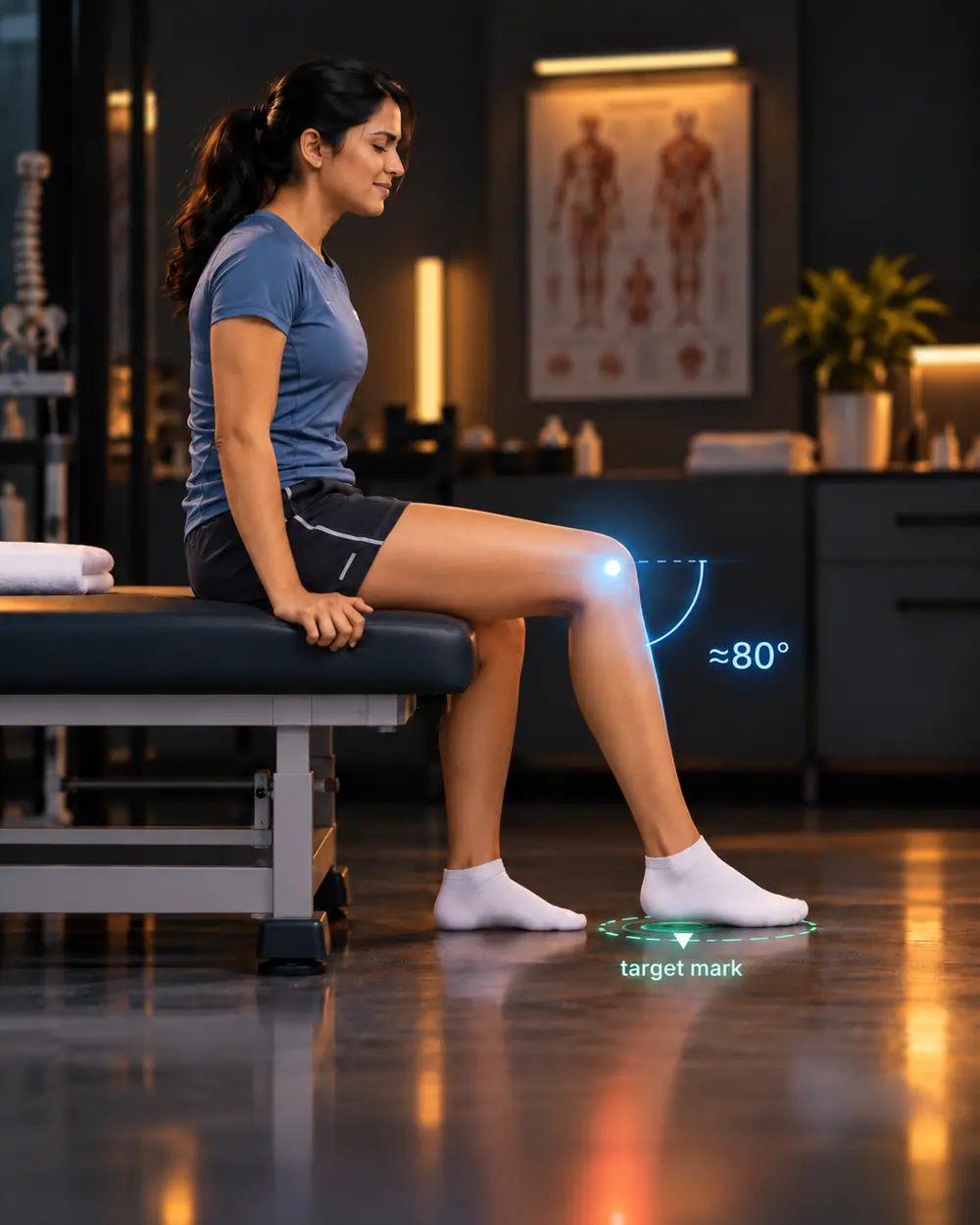
    Illustration, trial 2: the same woman, relaxed and smiling, slides her heel back to a glowing target mark on the floor, her knee glowing calm blue and bent to about 80 degrees.
    IMG-10B

    Relaxed heel slide to an external target, calm blue response.

    Trial 2 · External / task focus
    “Slide your heel back to touch this mark — breathe out as you go.”

    Heel glides on the floor, breathing continues — reaches ≈80°.

    Pain, illustrative
    5/10
    35%

    Kinesiophobia after TKA; postoperative pain more than doubles the odds (OR 2.3).

    Du et al., J Orthop Surg Res 2025 · meta-analysis, 11 studies, n = 4,039

    ≈1 in 5

    Still report pain 3 months after TKR; 12–15% up to 2 years (n = 598,498).

    Cheng et al., BMJ Open 2025 · meta-analysis

    Movement is context-sensitive. External focus beats internal for motor learning (Chua 2021). Fear left unaddressed limits ROM for up to 6 months (Brown 2020).
    Pro Physio · Clinical Education09

    Monday morning · Assess

    Four questions to add to every assessment

    1

    What does the patient notice?

    Interoception — what, where, how often.

    2

    What does it mean to them?

    Threat and uncertainty — or confidence.

    3

    What does the body do?

    Bracing, gripping, breath-holding, avoidance.

    4

    Does movement change with context?

    Internal vs external focus — the 90-second test.

    Plus: a complete medical screen, and validated measures where useful — TSK-11 (fear of movement), MAIA-2 (interoceptive awareness).
    Pro Physio · Clinical Education10

    Treat · Match the target

    Change the threat, not just the tissue

    TargetApproachEvidence anchor
    Threat & avoidanceGraded exposure to feared movementsFear-avoidance literature; Vlaeyen & Linton 2012
    Blurred body mapSensory discrimination training; graded motor imagery where indicatedGMI meta-analysis: Bowering et al., J Pain 2013
    Guarded motor strategyExternal-focus tasks; movement variability; capacity buildingWulf 2013; Hodges & Tucker 2011
    Autonomic stateBreathing retraining; pacing; sleep and activity rhythmAdjunctive; HRV rationale from Tracy et al. 2016
    Meaning & agencyEducation, shared experiments, patient-led winsBPS best-practice care; Lin et al., BJSM 2020
    The common thread: reframe the threat, then expose to movement with confidence and variety. Match the approach to the dominant driver found in assessment.
    Pro Physio · Clinical Education11

    Take home

    Three things to do differently

    1

    Don’t confuse vigilance with awareness

    Feeling more is not sensing better.

    2

    Treat guarding as information

    Bracing is the system’s attempt to create safety.

    3

    Build options, capacity and body trust

    Reframe threat, then graded, varied, confident movement.

    Don’t only ask what is tight. Ask what the system is protecting — and what experience will help it feel safe enough to move again.

    Pro Physio · Clinical Education12

    Evidence

    References

    1. GBD 2021 Low Back Pain Collaborators. Global burden of low back pain, 1990–2020, and projections to 2050. Lancet Rheumatol 2023;5(6):e316–29.
    2. Di Lernia D, Serino S, Riva G. Pain in the body: altered interoception in chronic pain conditions. Neurosci Biobehav Rev 2016;71:328–41.
    3. Gnall KE, et al. Changes in interoception in mind–body therapies for chronic pain: meta-analysis. Int J Behav Med 2024;31(6):833–47.
    4. Adamczyk W, Luedtke K, Saulicz E. Lumbar tactile acuity in low back pain: meta-analysis. Clin J Pain 2018;34(1):82–94.
    5. Bagg MK, et al. Graded sensorimotor retraining in chronic low back pain (RESOLVE): RCT. JAMA 2022;328(5):430–9.
    6. Rampazo ÉP, et al. Heart rate variability in adults with chronic musculoskeletal pain: systematic review. Pain Pract 2024;24(1):211–30.
    7. Markfelder T, Pauli P. Fear of pain and pain intensity: meta-analysis. Psychol Bull 2020;146(5):411–50.
    8. Kosek E, et al. Chronic nociplastic pain affecting the musculoskeletal system: clinical criteria and grading. Pain 2021;162(11):2629–34.
    9. Chua LK, et al. Superiority of external attentional focus: systematic reviews and meta-analyses. Psychol Bull 2021;147(6):618–45.
    10. Vlaeyen JWS, Linton SJ. Fear-avoidance model of chronic musculoskeletal pain: 12 years on. Pain 2012;153(6):1144–7.
    11. Bowering KJ, et al. Graded motor imagery and its components for chronic pain: meta-analysis. J Pain 2013;14(1):3–13.
    12. Wulf G. Attentional focus and motor learning: a review of 15 years. Int Rev Sport Exerc Psychol 2013;6(1):77–104.
    13. Hodges PW, Tucker K. Moving differently in pain: a new theory to explain the adaptation to pain. Pain 2011;152(3 Suppl):S90–8.
    14. Tracy LM, et al. Decreased heart rate variability in chronic pain: meta-analysis. Pain 2016;157(1):7–29.
    15. Lin I, et al. What does best practice care for musculoskeletal pain look like? Br J Sports Med 2020;54(2):79–86.
    16. Du X, et al. Prevalence and influencing factors of kinesiophobia after total knee arthroplasty: meta-analysis. J Orthop Surg Res 2025;20(1):332.
    17. Brown OS, et al. Effects of kinesiophobia on outcome following total knee replacement: systematic review. Arch Orthop Trauma Surg 2020;140(12):2057–70.
    18. Cheng HY, et al. Long-term pain after total hip or knee replacement: updated meta-analysis. BMJ Open 2025;15(5):e088975.
    Pro Physio · Clinical Education13