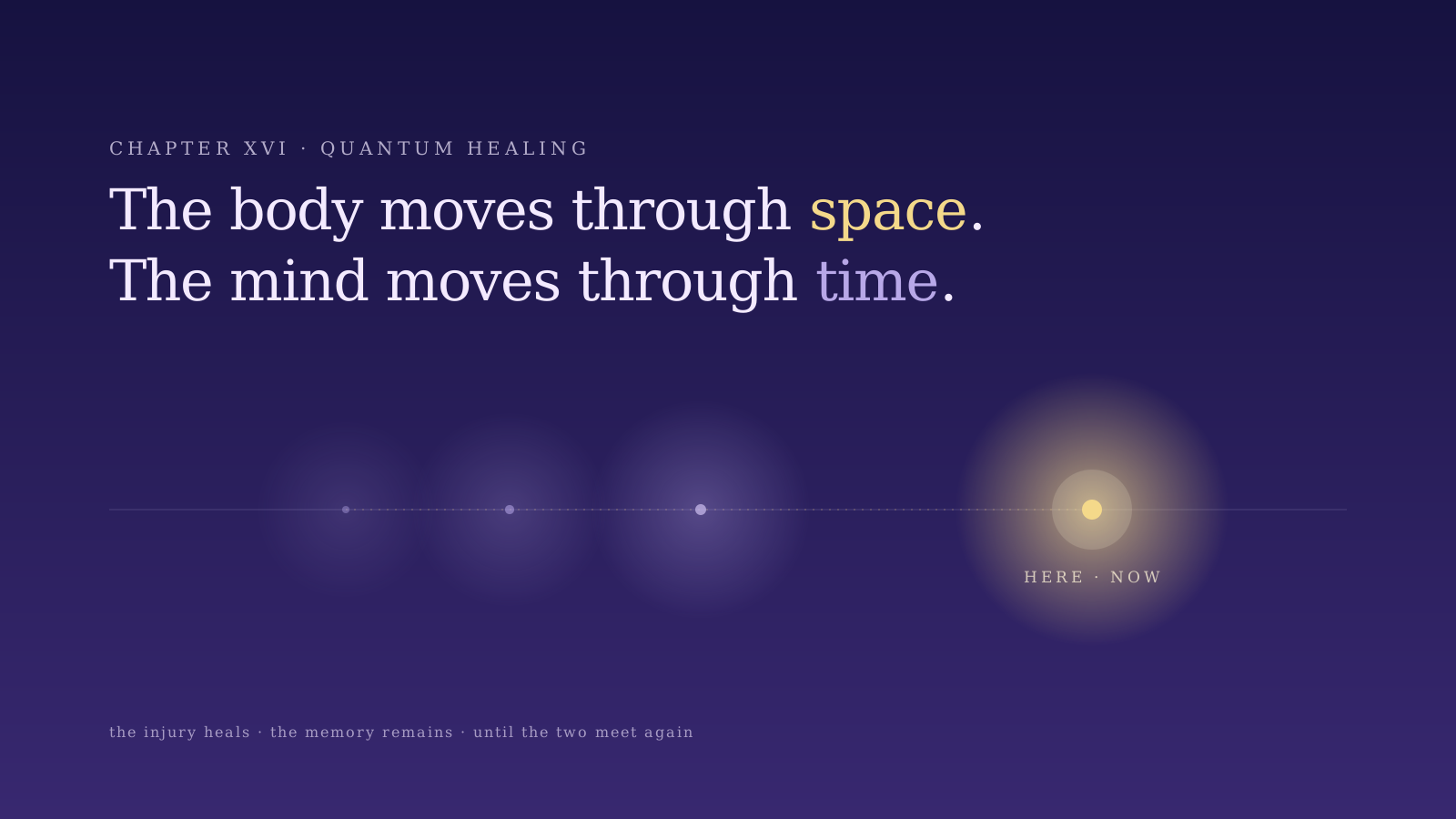
The body occupies one place at a time. It can never move into yesterday or tomorrow. The mind follows different rules — in a fraction of a second it travels years into the past or leaps decades into the future. As physiotherapists, we often watch tissue heal completely while the memory of the injury quietly stays behind.
The human body is a remarkable machine. It occupies only one place at a time. Every muscle contraction, every heartbeat, every breath occurs in the present moment. The body moves through space — through rooms, roads, mountains and race tracks — but it can never move into yesterday or tomorrow.
The mind, however, follows different rules. In a fraction of a second it can travel years into the past or leap decades into the future. It can replay old mistakes, relive old pain and rehearse future fears without moving a single inch.
As physiotherapists, we often witness this disconnect. A patient's tissues may have healed completely. Strength may have returned. Balance may be restored. Yet something still holds them back. The injury is gone. The memory remains.
Yashaswini was twenty-three years old when she tore her ACL. Cycling was not merely a sport for her. It was freedom. It was identity. It was movement distilled into its purest form. The accident happened during a competitive race. One moment she was pushing hard through a turn. The next, she was on the ground.
The diagnosis was clear: an anterior cruciate ligament tear. Months of rehabilitation followed. Like many athletes, she approached recovery with discipline. She completed every exercise. She strengthened her quadriceps. She rebuilt her endurance. She progressed through each phase exactly as prescribed. Her surgeon was satisfied. Her physiotherapist was satisfied. Objective testing showed excellent recovery. On paper, she was ready.
Yet when she returned to the bicycle, something felt wrong. Every fast descent created tension. Every sharp turn triggered hesitation. Every unexpected movement brought a flash of fear. Her body was healthy. Her mind was still injured.
Modern neuroscience helps explain why. When a traumatic injury occurs, the brain does not simply record damaged tissue. It records the entire experience — the sound, the emotion, the fear, the uncertainty. The brain creates a protective memory designed to prevent future danger. This mechanism is essential for survival. But sometimes protection outlives necessity.
The tissues heal. The threat disappears. Yet the nervous system continues to behave as though danger remains. The athlete is no longer responding to reality — she is responding to memory.
One afternoon during a rehabilitation session, Yashaswini described her experience. "I know my knee is fine," she said. "But every time I ride fast, it feels like the accident is about to happen again." That sentence revealed everything. Her body was riding in the present. Her mind was riding in the past. Two different timelines were competing for control.
Around this time, Yashaswini began exploring meditation. Initially she was skeptical; it seemed unrelated to cycling performance. She expected stronger muscles to solve her problem. Instead, she discovered that strength was never the issue. Attention was.
For twenty minutes twice a day, she learned to sit quietly and allow the mind to settle beneath its constant stream of thoughts. Gradually, something changed. She became aware of how frequently her mind revisited the accident — not during cycling alone, but during conversations, during meals, before sleep. The memory was not simply stored. It was being repeatedly relived. Each replay taught the nervous system that the danger was still present.
Meditation interrupted this cycle — not by suppressing thoughts, but by creating space around them. For the first time, she could observe the memory without becoming trapped inside it.
At the same time, her physiotherapy shifted emphasis. Instead of focusing only on performance metrics, sessions increasingly incorporated body awareness. The goal was simple: bring attention back to direct sensory experience.
Feel the contact of the foot on the pedal. Notice the rhythm of breathing. Observe the movement of the hips. Experience the pressure through the handlebars. Return to what is happening now — not what happened then. Every moment of awareness became an anchor. A bridge between mind and body. A return to the present.
"The fear gradually lost its intensity. Not because it was fought. But because it was no longer being fed."
Weeks passed. Then months. One race morning, something felt different. She later struggled to describe it. There was no dramatic breakthrough, no sudden revelation — just a quiet sense of trust. Trust in her body. Trust in her training. Trust in the present moment.
When the race began, she stopped analysing. She stopped anticipating disaster. She stopped replaying old memories. Instead, she rode. Fully. Completely. Here. Now.
That day, Yashaswini won a medal. The podium photograph captured a smiling athlete holding her achievement high above her head. Most people saw victory. Few saw the deeper healing that had occurred. The medal was not proof that her knee had recovered — the knee had recovered months earlier. The medal represented something else: the moment her mind finally caught up with her body.
In quantum physics, observers influence what they perceive. In healing, attention influences what we experience. Where attention goes, energy follows. Where awareness rests, healing often begins. The body continuously communicates through sensation. The mind continuously communicates through thought. Suffering frequently emerges when these two conversations become disconnected. Health emerges when they meet.
Many healing traditions emphasise presence. Not because the past is unimportant, nor because the future should be ignored — but because life itself unfolds nowhere else.
The body has always understood this. It has never left the present moment. The challenge belongs to the mind.
And the invitation of healing may simply be this: to stop travelling through time long enough to join the body where it has been waiting all along. Here. Now.
General education, not a substitute for personal medical advice — see our medical disclaimer.
Quantum Healing brings together patient encounters and clinical reflections documented by therapists across the Pro Physio network over a decade of practice. Compiled and edited by the Pro Physio Editorial Team.
If something in this chapter resonates — or you're living with pain, limited movement, or a recovery that hasn't gone as expected — we're here.
Talk to a physiotherapist First consultation · +91 98808 49999 · Replies in under 2 minutes