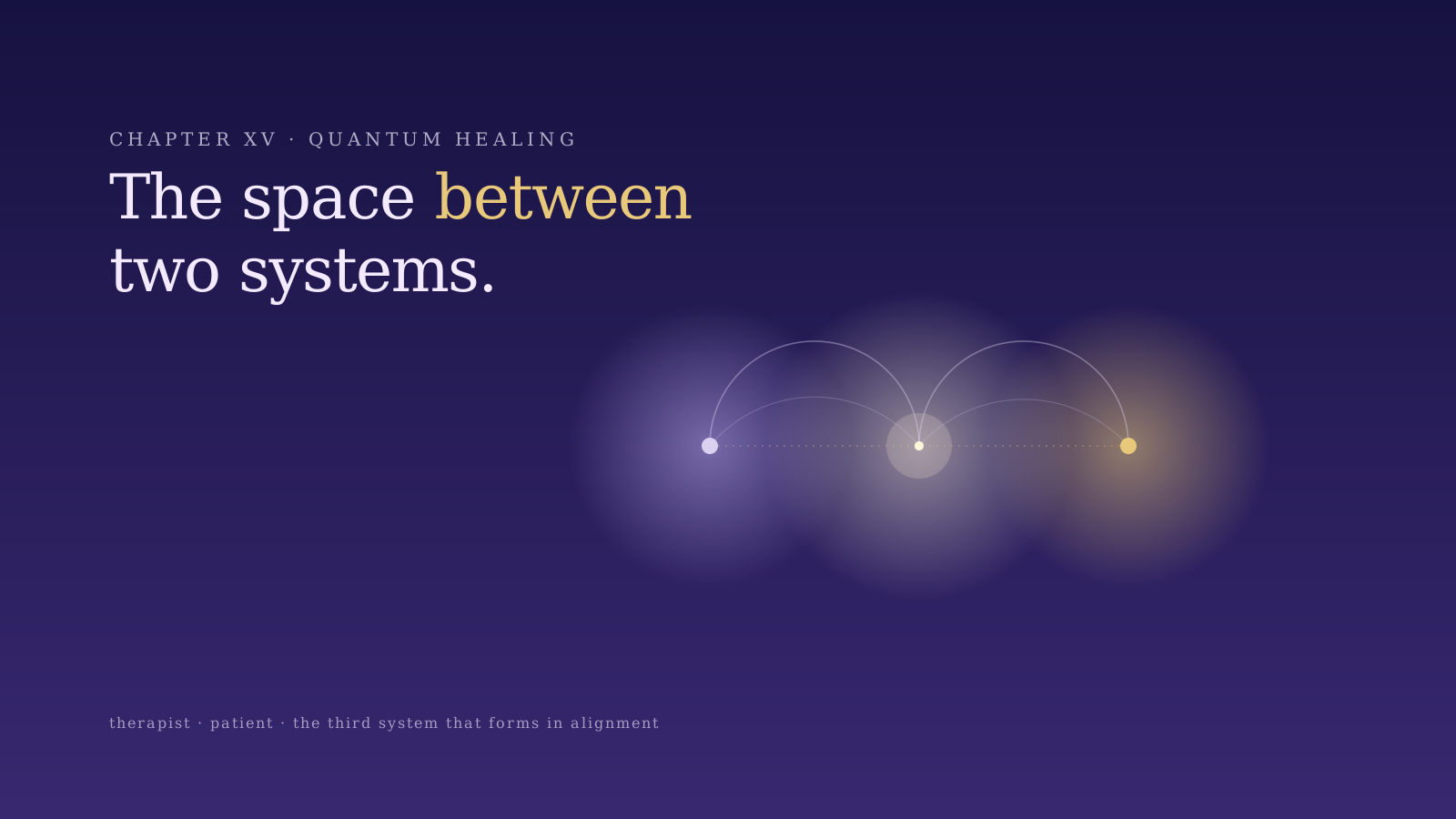
There is something we rarely speak about in healing. It does not appear in reports. It cannot be reduced to numbers. And yet it determines outcomes more than most things we measure. It exists between two people. Not in the therapist. Not in the patient. But in the space between them — the third system that forms when two nervous systems align.
There is something we rarely speak about in healing. Not because it is unimportant. But because it cannot be easily measured. It does not appear in reports. It is not visible in scans. It cannot be reduced to numbers. And yet it determines outcomes more than most things we measure.
It exists between two people. Not in the therapist. Not in the patient. But in the space between them.
Before any movement is guided, before any correction is made, two systems meet. Two nervous systems. Two histories. Two predictive models of the world. And in that moment, something silent begins: calibration. The brain does not ask "what technique will be used?" It asks "what is this environment?" Safe? Uncertain? Demanding? Supportive? Based on that answer, everything changes. When two people interact, a third system is created. Not metaphorically. Biologically. Formed through visual input (facial expression, eye contact), auditory cues (tone, rhythm, pauses), somatic signals (posture, proximity, touch) and temporal alignment.
Studies in interpersonal neurobiology show that when two individuals interact deeply, their physiology begins to coordinate. The nervous system is designed to align.
At first, one system regulates another. A calm therapist reduces patient vigilance. But at a deeper level, something else happens — the systems begin to co-create a state. Not therapist to patient. Not patient to therapist. Something mutual. A feedback loop: calm → calm → deeper calm. Trust → trust → deeper trust. Within that loop, a new baseline emerges. In this state, movement changes. Not because it is corrected, but because it is no longer resisted. Basal ganglia restores automaticity. Motor cortex reduces over-control. Cerebellum refines coordination. Brainstem reduces global tone. Movement becomes fluid, efficient, effortless. Pain perception shifts: signal amplification reduces, endogenous opioid activity rises, threat interpretation falls.
From the outside, it may look simple — a therapist guiding a movement, a patient responding. But beneath that simplicity, neural networks are synchronising, predictive models are updating, defensive patterns are dissolving. This is not technique. This is interaction. If alignment does not occur, the system remains guarded, movement stays effortful, pain persists. Not because the method is wrong. Because the environment is not permissive. Healing requires permission. And permission emerges from alignment. Over years of practice, a pattern becomes clear: the most effective sessions are not the most technical. They are the most aligned. Where you are fully present, the patient is fully engaged, there is no urgency, no resistance — and in that space, change happens effortlessly.
"Healing is not delivered. It is allowed. Not imposed. Not forced. But created through relationship. When two systems meet without resistance, something larger than both emerges. And in that emergence — healing unfolds."
You are not just a therapist. You are part of a system. Every interaction creates a field.
And that field determines whether the body protects, adapts — or heals.
So the question is not just what will you do? But who are you when you are with another human being? Because in that answer lies the future of healing.
General education, not a substitute for personal medical advice — see our medical disclaimer.
Quantum Healing brings together patient encounters and clinical reflections documented by therapists across the Pro Physio network over a decade of practice. Compiled and edited by the Pro Physio Editorial Team.
If something in this chapter resonates — or you're living with pain, limited movement, or a recovery that hasn't gone as expected — we're here.
Talk to a physiotherapist First consultation · +91 98808 49999 · Replies in under 2 minutes